
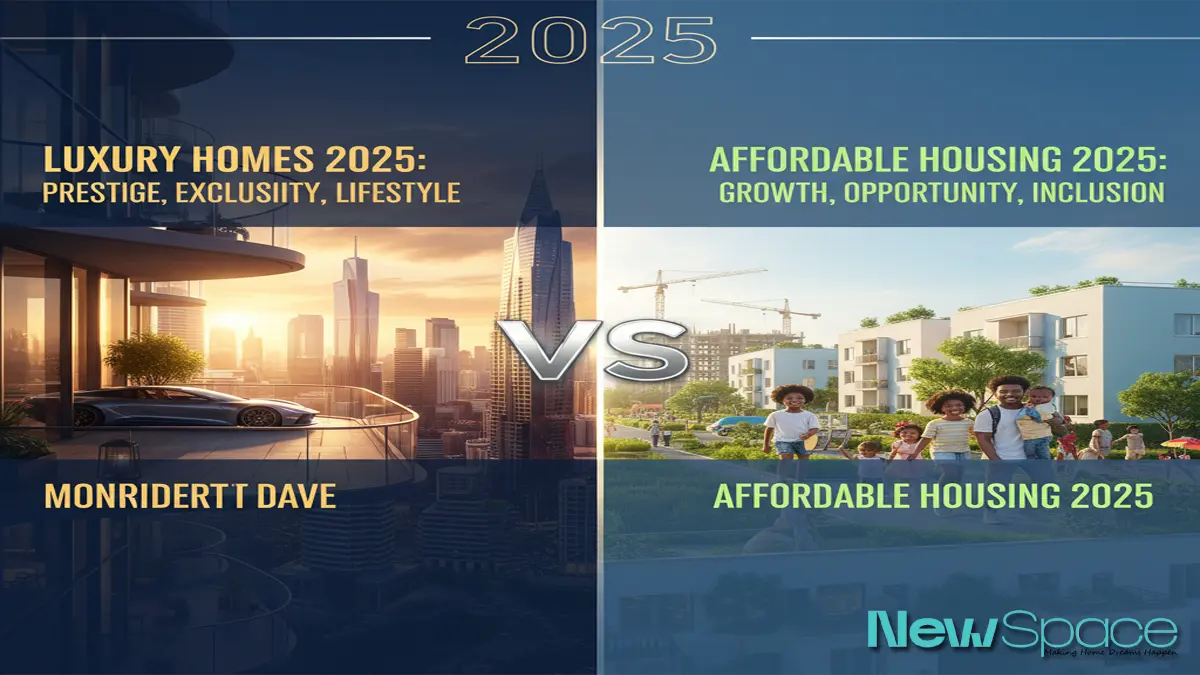
Luxury Homes vs Affordable Housing in 2025: Market Trends & Buyer Demand
By NewSpace | 🏡 Real Estate Market Insight | Real Estate | Crafting Dreams Into Adresses
Discover where the Indian real estate market is heading in 2025 luxury homes or affordable housing. Compare buyer demand, trends, and returns to make the right investment choice.
Introduction: The Great Divide in Indian Real Estate
As we move deeper into 2025, the Indian real estate market is showing a fascinating contrast. On one side, the luxury housing segment continues to thrive among affluent buyers and NRIs seeking exclusivity, modern amenities, and prime locations. On the other side, affordable housing remains the backbone of mass home ownership, supported by government incentives and rising urban migration.
Both sectors are evolving rapidly — shaped by changing buyer sentiment, global economic shifts, and technological innovation in construction and marketing. But the big question remains:
👉 Which segment will dominate the Indian real estate market in 2025 — luxury homes or affordable housing?
Let’s dive into buyer behavior, market trends, and return potential to find out.
1. Buyer Demand: Two Different Stories
🏙️ Luxury Housing: Aspirational and Experience-Driven
In 2024–25, India’s luxury real estate has witnessed record growth, led by top-tier cities like Mumbai, Delhi-NCR, Bengaluru, and Hyderabad. Wealthy buyers, especially high-net-worth individuals (HNIs) and NRIs, are driving this surge.
Key reasons behind the luxury boom:
- Rising disposable incomes and global exposure.
- Desire for larger homes with private workspaces post-pandemic.
- Investment diversification by affluent families.
- Premium lifestyle amenities and gated community living.
According to Knight Frank’s 2024 Wealth Report, India saw a 15–20% rise in luxury property transactions compared to pre-pandemic levels. Cities like Gurugram, Pune, and Hyderabad are witnessing unprecedented demand for ₹3–10 crore properties.
💬 “Luxury buyers are no longer purchasing for prestige alone — they’re seeking a global lifestyle within India.”
🏡 Affordable Housing: The Foundation of India’s Growth
While luxury dominates the headlines, affordable housing still holds the majority share in volume. Government initiatives like Pradhan Mantri Awas Yojana (PMAY) and the push for Housing for All have brought home ownership within reach for the middle class.
Key drivers of affordable housing demand:
- Urban migration and job growth in Tier 2 and Tier 3 cities.
- Interest subsidies and lower stamp duties for first-time buyers.
- Availability of smaller ticket-size homes (₹20–50 lakhs).
- Developers focusing on compact, functional designs.
Reports suggest that in 2025, over 60% of home sales in India will continue to come from the affordable and mid-income segments.
2. Market Trends: How Each Segment is Evolving
💎 Luxury Segment Trends in 2025
- Smart Homes & Tech Integration:
Voice-controlled lighting, AI-powered security, and EV charging stations are standard in luxury projects. - Branded Residences:
Global luxury brands (like Trump, Four Seasons, and Porsche Design) are collaborating with Indian developers to bring international standards to India. - Sustainability as a Status Symbol:
Eco-luxury is the new trend — green buildings, solar rooftops, and wellness-focused designs are appealing to conscious buyers. - Global Demand:
NRIs from UAE, UK, and the US are returning to invest in India’s stable property market.
🏠 Affordable Segment Trends in 2025
- Tier 2 & 3 Cities Rising:
Cities like Indore, Bhubaneswar, Coimbatore, and Surat are emerging as affordable housing hubs. - Government Support Continues:
Incentives, tax breaks, and reduced GST keep the segment active. - Smarter Compact Living:
Developers are offering co-living and community-style projects with shared amenities. - Tech-Enabled Sales:
Virtual tours, digital documentation, and online bookings have made affordable housing more accessible.
3. Investment Returns: Luxury vs Affordable
| Factor | Luxury Homes | Affordable Housing |
|---|---|---|
| Initial Investment | ₹1.5 crore and above | ₹20–60 lakhs |
| Rental Yield | 2–3% | 4–6% |
| Capital Appreciation (5 years) | 20–35% | 30–50% |
| Liquidity | Moderate (limited buyers) | High (strong demand) |
| Buyer Profile | NRIs, HNIs, Entrepreneurs | Salaried professionals, first-time buyers |
✅ Insight: Affordable housing generally offers better rental yields and liquidity, while luxury homes provide prestige and lifestyle-driven appreciation.
4. Case Study: Luxury Success Story
Location: Gurugram, Haryana
Developer: DLF Limited
Project: DLF The Camellias
Launched in 2014, these ultra-luxury apartments priced at ₹15–25 crore have seen value appreciation of over 80% by 2025. The combination of location, exclusivity, and limited inventory created unmatched demand among HNIs.
Takeaway: In prime markets, branded luxury properties with world-class amenities offer substantial long-term gains.
5. Case Study: Affordable Housing Success Story
Location: Pimpri-Chinchwad, Pune
Developer: Mahindra Lifespaces
Project: Happinest
Launched around ₹30 lakhs, these affordable apartments saw consistent demand due to strong connectivity and IT job growth. Prices rose to nearly ₹50 lakhs in 4 years — a 60% appreciation, plus high rental demand from working professionals.
Takeaway: Affordable homes near employment zones yield faster returns and continuous cash flow.
6. Challenges for Both Segments
Luxury Housing Challenges:
- Limited liquidity — smaller buyer pool.
- High property tax and maintenance costs.
- Sensitivity to economic downturns.
Affordable Housing Challenges:
- Rising land and construction costs squeezing developer margins.
- Delays in project approvals and infrastructure gaps.
- Quality control issues in low-cost housing projects.
7. The 2025 Forecast: Where the Market is Headed
🔹 Luxury Housing Outlook:
The segment will continue growing, especially in metro cities and NRI markets. Developers will focus on limited-edition luxury, blending sustainability with technology. Expect 10–15% price growth in 2025 for premium locations.
🔹 Affordable Housing Outlook:
Affordable and mid-income housing will dominate India’s housing volume, driven by Tier 2 & Tier 3 expansion and government support. Expect steady appreciation of 8–10% annually with stable rental yields.
Conclusion: Choose According to Your Goals
So, which segment should you choose — Luxury or Affordable?
✅ Go for Luxury Homes if you:
- Have strong capital reserves.
- Seek exclusivity, brand value, and prestige.
- Plan for long-term appreciation and global-standard living.
✅ Go for Affordable Housing if you:
- Want faster resale potential and steady rental income.
- Are a first-time homebuyer or middle-income investor.
- Believe in mass-market stability and long-term demand.
Ultimately, both segments have a place in India’s real estate ecosystem. The trick is to balance aspiration with affordability — invest smart, and align your portfolio with your financial goals and risk appetite.
✍️ Editorial Note
This article is intended for educational purposes only. Real estate investments are subject to market risks. Readers are advised to consult professional financial advisors before making investment decisions.
✍️ Editorial Note
This article is intended for informational purposes and reflects emerging trends in the real estate sector. The insights shared are based on market research, urban housing studies, and expert opinions. Readers are encouraged to consult with local real estate professionals or financial advisors before making investment or housing decisions.