
Ready-to-Move vs Under-Construction Properties: Pros, Cons & Hidden Costs Explained
By NewSpace | 🏡 Real Estate Market Insight | Real Estate | Crafting Dreams Into Adresses
How to Choose Between Ready-to-Move and Under-Construction Properties
Confused between ready-to-move and under-construction homes? Discover the pros, cons, and hidden costs of each to make the right real estate decision in 2025.
🏡 Introduction: The Homebuyer’s Dilemma
Every homebuyer in India eventually faces one of the toughest decisions —
“Should I buy a ready-to-move property or an under-construction one?”
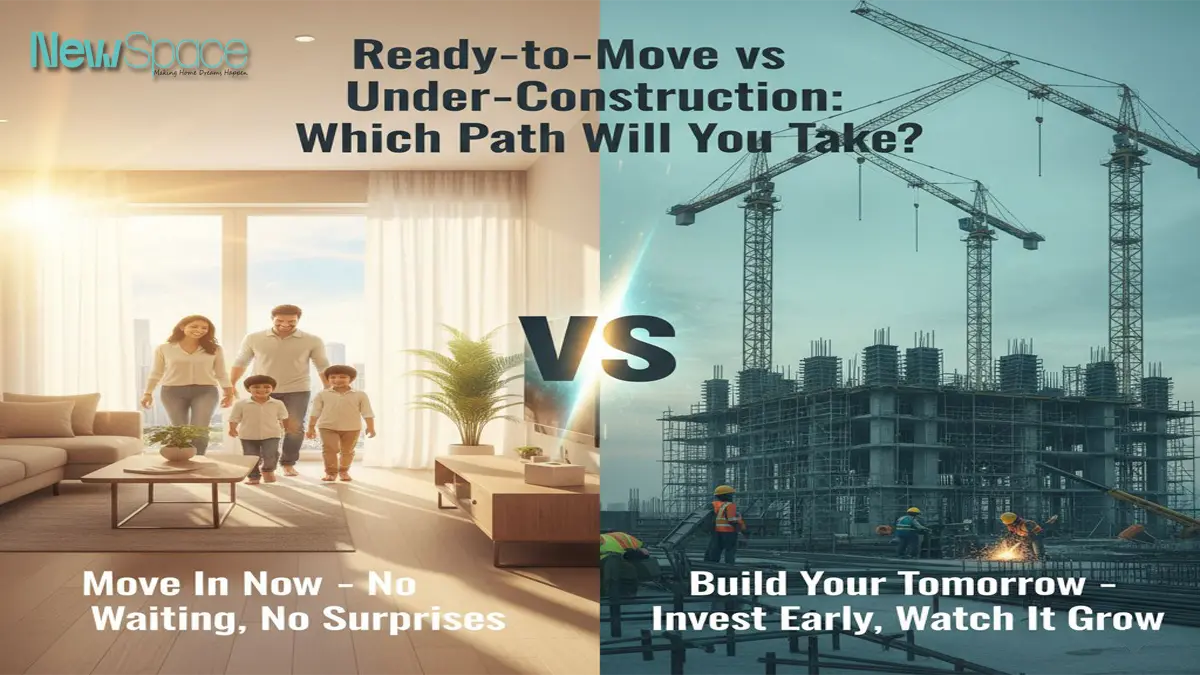
Both options have their own charm and challenges. Ready-to-move homes offer instant possession and peace of mind, while under-construction properties often promise affordability and appreciation potential.
But beyond the obvious, there are hidden costs, legal nuances, and practical differences that can significantly impact your financial planning and lifestyle.
In this blog, let’s explore — in simple, human language — the pros, cons, and hidden costs of both, so you can choose what’s right for your situation.
🏠 What is a Ready-to-Move Property?
A ready-to-move property is a completed home that’s ready for immediate possession. You can physically inspect the flat, verify amenities, and move in as soon as you finish paperwork and payments.
These are often preferred by:
- Families looking for immediate relocation.
- End-users (not investors) who don’t want construction uncertainty.
- Buyers who want to avoid paying rent and EMI simultaneously.
🏗️ What is an Under-Construction Property?
An under-construction property is one that’s still being built or in the final stages of development. Buyers usually book it in advance at a lower price, making it popular among early investors.
These are often preferred by:
- Young professionals planning long-term housing.
- Investors seeking property appreciation during construction.
- Buyers with flexible timelines and budgets.
⚖️ Comparison at a Glance
| Factor | Ready-to-Move Property | Under-Construction Property |
|---|---|---|
| Possession | Immediate | 2–5 years (depending on project) |
| Price | Higher | Lower (10–25% cheaper) |
| Risk | Minimal | Depends on builder reliability |
| Customization | Limited | Possible before completion |
| Tax Benefits | Starts immediately | After possession |
| Appreciation Potential | Moderate | High (if project is timely) |
| Hidden Costs | Registration, maintenance, furnishing | GST, delay, EMI + rent overlap |
✅ Advantages of Ready-to-Move Properties
1. Immediate Possession — No Waiting, No Delays
You can move in right away. For working families or people relocating to a new city, this is a huge plus.
2. What You See is What You Get
You can physically inspect everything — location, amenities, ventilation, neighborhood, and actual construction quality — before paying the full amount.
3. No GST Applicable
Since July 2019, GST does not apply to ready-to-move properties with an Occupancy Certificate (OC). That’s a direct saving of 5–12% compared to under-construction options.
4. Lower Risk of Builder Defaults
The project is already completed, so there’s no worry about construction halts or builder insolvency.
5. Tax Benefits Start Immediately
If you’ve taken a home loan, you can immediately start claiming tax benefits under Sections 24(b) and 80C.
⚠️ Disadvantages of Ready-to-Move Properties
1. Higher Price
You pay a premium for completion and convenience — typically 10–25% more than similar under-construction homes.
2. Limited Options
Most completed projects have limited inventory left — you might not get your preferred layout, floor, or facing direction.
3. Older Construction
Some ready-to-move flats may have been completed months or years ago, meaning the structure might not be as modern or energy-efficient as newer designs.
4. Immediate Maintenance Costs
You’ll start paying society maintenance, property tax, and utility bills right after possession.
✅ Advantages of Under-Construction Properties
1. Lower Cost and Flexible Payment
The biggest benefit — you buy cheaper. Developers often offer pre-launch discounts and construction-linked payment plans, making it easier on your pocket.
2. Higher Appreciation Potential
If you buy early in a developing area or before project completion, property values can rise 20–40% by possession time.
3. Customization Options
Depending on the builder, you may have the flexibility to modify interiors, flooring, or fittings before completion.
4. Developer Offers & Schemes
Builders frequently offer subvention schemes, early-bird discounts, or waived charges to attract buyers in early stages.
⚠️ Disadvantages of Under-Construction Properties
1. Possession Delays
The biggest risk — delays due to approvals, funding issues, or slow construction. Even under RERA, projects can still stretch 6–18 months beyond promised dates.
2. GST & Hidden Costs
Unlike ready homes, 5% GST applies (without ITC). Additionally, you’ll pay for parking, club membership, electricity setup, and other add-ons.
3. No Immediate Tax Benefits
Home loan tax deductions apply only after possession — so if you buy early, you can’t claim benefits right away.
4. Quality Uncertainty
What’s shown in brochures may differ from reality. Until possession, you can’t inspect the final product.
💰 Hidden Costs You Shouldn’t Ignore
Whether you buy ready or under-construction, here are the hidden costs that often surprise buyers:
| Hidden Cost Type | Ready-to-Move | Under-Construction |
|---|---|---|
| Registration & Stamp Duty | ✅ | ✅ |
| GST (5%) | ❌ | ✅ |
| Maintenance Deposit | ✅ | ✅ |
| Parking & Club Charges | ✅ | ✅ |
| Interior & Furnishing | ✅ | ✅ |
| Delay in Possession (Rent + EMI overlap) | ❌ | ✅ |
| Holding Costs (Tax, Insurance) | ✅ | ✅ |
💡 Tip: Always ask your builder or agent for a “Total Cost Sheet” — not just the base price — before booking.
🔍 Real-Life Example
Scenario 1: Ready-to-Move Buyer (Neha, Gurgaon)
- Bought a 3BHK for ₹1.2 Cr in a completed project.
- No GST, immediate possession, started living and saving ₹25,000/month in rent.
- Slightly higher purchase price, but total peace of mind.
Scenario 2: Under-Construction Buyer (Ravi, Pune)
- Booked at ₹90 lakhs in 2022.
- By 2025, price appreciated to ₹1.15 Cr — ₹25 lakh paper profit.
- However, possession delayed by 9 months, forcing him to pay rent + EMI together.
👉 Both benefited in different ways — it depends on your timeline and tolerance for risk.
🧭 Which Should You Choose?
Choose Ready-to-Move if you:
✅ Need immediate housing.
✅ Want zero construction risk.
✅ Value peace of mind over small cost savings.
✅ Don’t want to deal with GST or project delays.
Choose Under-Construction if you:
✅ Have time to wait 2–4 years.
✅ Are investing for appreciation, not immediate use.
✅ Want flexible payments and early-bird pricing.
✅ Trust the developer’s track record.
🏁 Conclusion: Match the Property to Your Purpose
There’s no “one-size-fits-all” in real estate. The right choice depends on your priorities — time, budget, and risk comfort.
- If you want certainty, transparency, and immediate use, go for a ready-to-move property.
- If you’re looking for affordable entry and long-term growth, an under-construction home might be ideal.
Always remember to verify RERA registration, builder credentials, and possession timelines before signing any agreement.
✍️ Editorial Note
This article is meant for informational and educational purposes only. Real estate decisions should be based on personal financial planning and verified project details. Always consult legal and financial professionals before making any purchase.
✍️ Editorial Note
This article is intended for informational purposes and reflects emerging trends in the real estate sector. The insights shared are based on market research, urban housing studies, and expert opinions. Readers are encouraged to consult with local real estate professionals or financial advisors before making investment or housing decisions.